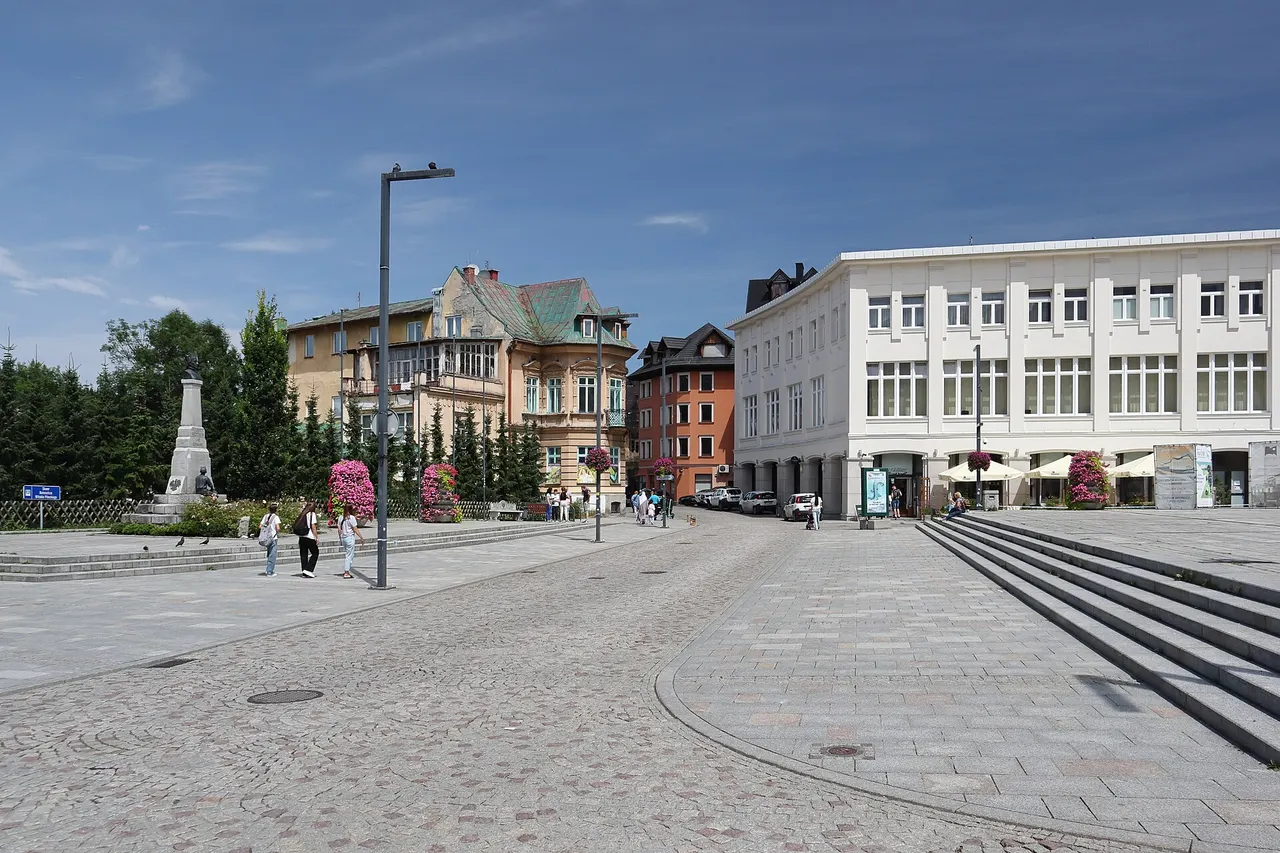
Written on 11 November 2026, Poland's Independence Day. The events follow the Tatra Museum historian Lesław Dall, the Museum of Polish History and the Polish Press Agency. Where sources disagree, we say so. Header photo: Independence Square in Zakopane, August 2024, by Cybularny, Wikimedia Commons, CC0, resized.
- 13 October 1918: a public meeting declares for an independent Poland and elects a National Organisation led by the writer Stefan Żeromski.
- 31 October: Polish officers disarm the Austrian guard and gendarmes and take over the post office and the railway station, without a shot fired.
- 1 November: a National Council takes power. 2 November: the soldiers swear an oath to Poland at the Grunwald Monument.
- 16 November: the Council steps down and Zakopane becomes part of the reborn Polish state.
- From Willa Storczyk the Grunwald Monument is about 2.1 km, a 28-minute walk, or a 5-minute bus ride plus 7 minutes on foot.
Zakopane in autumn 1918
For over a century Poland did not exist on the map. Zakopane lay in Galicia, the Polish part of the Austrian Empire. It was still officially a large village, but also the most fashionable health resort in the Polish lands, full of writers, painters, politicians and soldiers of the Polish Legions on sick leave. Stefan Żeromski, then the best-known Polish novelist, spent the whole of the First World War here and was respected by the highlanders as well as by the visitors.
By early October 1918 it was clear that the Habsburg monarchy would not survive the war. On 7 October the Regency Council in Warsaw proclaimed an independent Poland, but in Galicia Austrian officials were still in their offices and Austrian gendarmes still on the streets. Zakopane decided not to wait.
13 October 1918: the meeting and the resolution
The head of the municipality, Wincenty Regieć, called a public meeting for Sunday 13 October without asking the Austrian authorities, announcing it on handwritten notes. Accounts differ: Tatra Museum historian Lesław Dall writes of about 200 people in the hall of the Sokół gymnastics society by the market square, while other accounts speak of nearly 500 at the Grunwald Monument. The two places are a few dozen metres apart.
A lawyer, Józef Diehl, read out a resolution, which the meeting adopted. It called for an independent and united Poland, recognised the Polish National Committee in Paris as the voice of the nation, and demanded that the regions of Spisz and Orawa south of the Tatras, then part of the Kingdom of Hungary, be joined to Poland. In effect, the people of Zakopane declared themselves citizens of a free Poland while still officially subjects of the Emperor.
The meeting set up a National Organisation with a 32-member board. Żeromski became chairman, with Franciszek Pawlica, Major Mariusz Zaruski and Wincenty Szymborski as his deputies. Żeromski later wrote, half joking, that he had been given an almost dictatorial power over Zakopane and the little valleys around it.
31 October: disarmed without a shot
At noon on 31 October 1918 an Officers' Committee led by Captain Marian Bolesławowicz disarmed the Austrian guard in Zakopane. Polish officers and legionnaires took the guardhouse and the arms and ammunition store, then disarmed the gendarmerie and took over the post office and the railway station. There was no fighting. The soldiers placed themselves under the National Organisation, and from that day Austria no longer ruled in Zakopane.
1–16 November: the National Council and the oath
On 1 November, All Saints' Day, the National Organisation, now joined by the left including the Polish Socialist Party, became a National Council. Żeromski chaired it and was called the president of the Republic of Zakopane, although no such office formally existed. The next day, 2 November, on the market square below the statue of King Władysław Jagiełło, the soldiers took a public oath of loyalty to Poland in front of Żeromski. They still wore Austrian uniforms, because there were no others.
On 11 November, the date Poland now celebrates as Independence Day, Józef Piłsudski took military command in Warsaw. Five days later, on 16 November 1918, the National Council in Zakopane stepped down and the authorities of the new Polish state took over. The Republic of Zakopane was never an attempt to break away. It was a Polish government on the spot for the few weeks between the collapse of the old power and the arrival of the new one.
Timeline
| Date | What happened |
|---|---|
| 7 Oct 1918 | The Regency Council in Warsaw proclaims Polish independence |
| 13 Oct 1918 | Public meeting in Zakopane, resolution for an independent Poland, National Organisation led by Stefan Żeromski |
| 28 Oct 1918 | The Polish Liquidation Commission is set up in Krakow to take Galicia over from Austria |
| 31 Oct 1918, noon | Austrian guard and gendarmes disarmed, arms store, post office and station taken over |
| 1 Nov 1918 | The National Council takes power in Zakopane |
| 2 Nov 1918 | Soldiers swear their oath at the Grunwald Monument |
| 11 Nov 1918 | Józef Piłsudski takes military command in Warsaw |
| 16 Nov 1918 | The Council steps down, Zakopane becomes part of the Second Polish Republic |
The people behind it
Stefan Żeromski
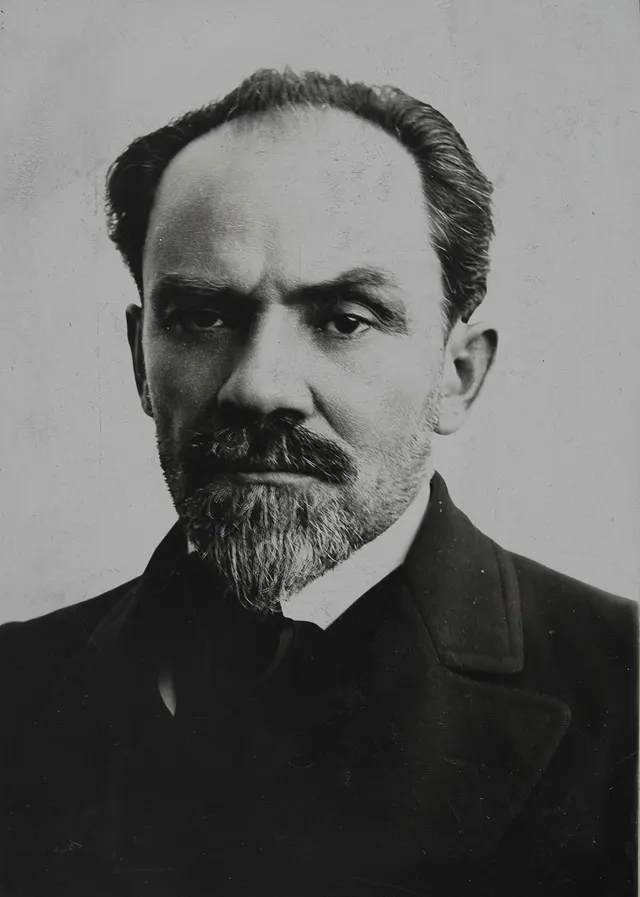
Novelist, author of The Homeless People and Ashes. He lived in Zakopane on and off from 1903 and without a break during the war. Chairman of the National Organisation and then the National Council, the informal president of the Republic of Zakopane. His standing let people of very different views work together.
Wincenty Regieć
Head of the Zakopane municipality, who called the meeting of 13 October on his own responsibility.
Franciszek Pawlica
President of the Highlanders' Union and Żeromski's deputy. Seven years earlier he had started the Grunwald Monument, where the soldiers swore their oath in 1918.
Mariusz Zaruski
Army major, mountaineer, sailor and founder of the Tatra mountain rescue service TOPR in 1909. He died in a Soviet prison in Kherson in 1941 and has a symbolic grave in Zakopane. After the Second World War TOPR was led by Tadeusz Pawłowski, whose story we tell in a separate article.
Wincenty Szymborski
Manager of Count Władysław Zamoyski's Zakopane estate and Żeromski's third deputy. His daughter Wisława, born in 1923, won the Nobel Prize in Literature in 1996.
Was Zakopane really the first?
You will often read that Zakopane was the first place in the old Polish lands to throw off foreign rule. The details are worth knowing, because several places claim the title:
- 7 October: the Regency Council proclaimed independence in Warsaw, but the city was still under German occupation.
- 13 October: the Zakopane resolution was one of the earliest grassroots declarations of a free Poland in Galicia, though Austrian officials and soldiers were still in town.
- 31 October: Zakopane disarmed the Austrians and from then on governed itself. The Tatra Museum calls it the first place in the Polish lands to throw off the occupier's rule on its own. On the morning of the same day, Lieutenant Antoni Stawarz disarmed the Austrian barracks in Podgórze in Krakow, and Krakow also calls itself the first.
The fair answer: Zakopane was one of the very first places of a free Poland, and 13 October is the earliest date you can attach to it. Either way, a small mountain town did it by itself, without bloodshed and four weeks before 11 November.
Places to see today
All of these fit into one afternoon. Distances are from Willa Storczyk at Droga na Bystre 1, walking times at an easy pace.
| Place | Link to 1918 | From Willa Storczyk |
|---|---|---|
| Grunwald Monument, Independence Square (plac Niepodległości) | The old market square, the soldiers' oath on 2 November 1918 | About 2.1 km, 28 min on foot |
| Sokół building, ul. Orkana 2 | According to the Tatra Museum, the meeting of 13 October was held here | Next to the square, about 2.1 km |
| Tatra Museum, Krupówki 10 | Collections and research on 1918 in Zakopane | About 2.4 km, 32 min on foot |
| Villa Oksza, ul. Zamoyskiego 25 | Tatra Museum gallery, venue of the centenary exhibition | About 900 m, 12 min on foot |
| Pęksowy Brzyzek cemetery | Symbolic grave of Mariusz Zaruski | About 2.9 km, 38 min on foot |
The Grunwald Monument and Independence Square
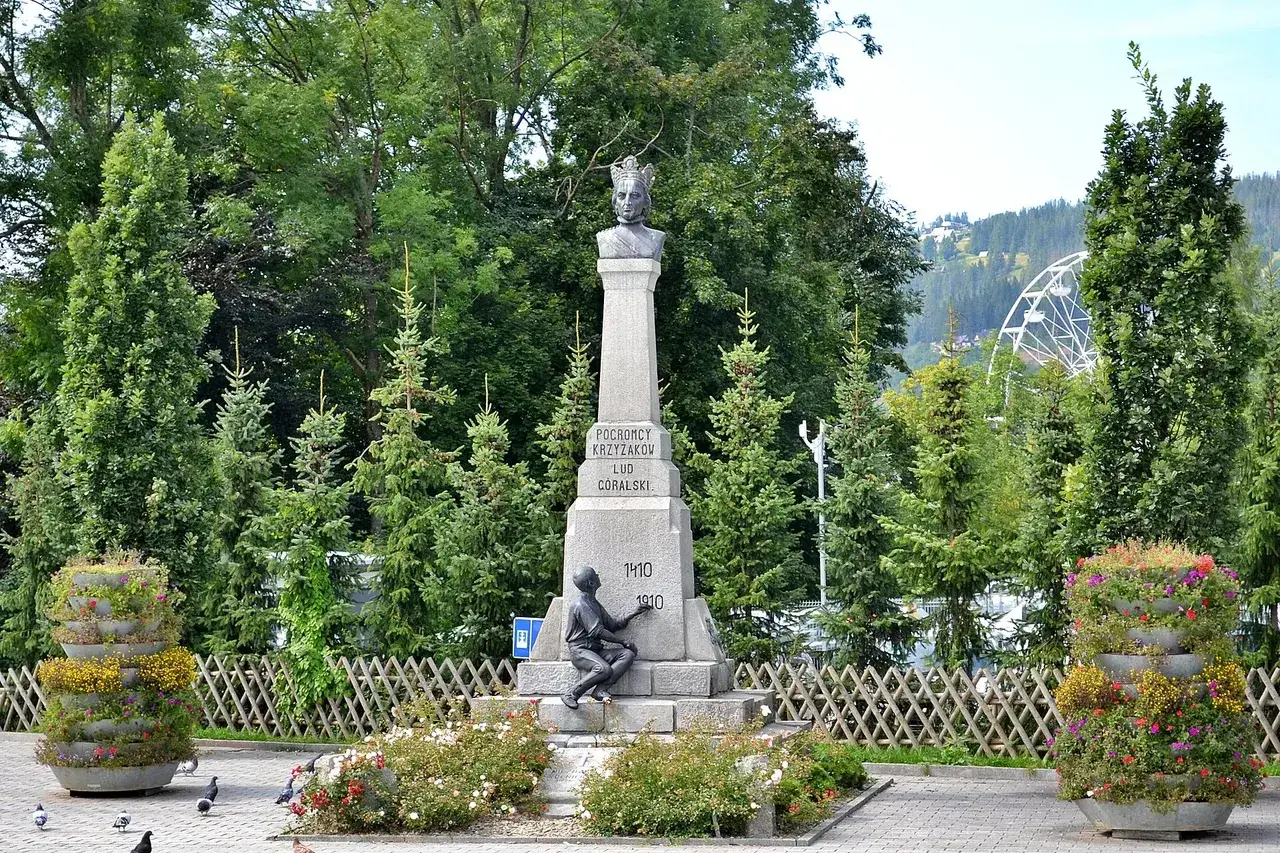
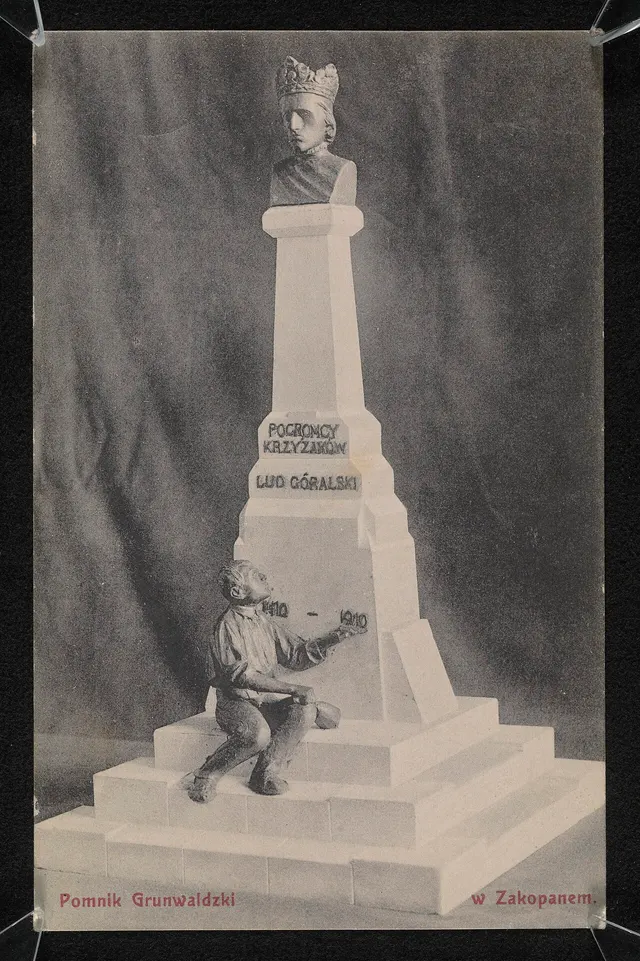
The granite column with a bronze bust of King Władysław Jagiełło was put up on the Zakopane market square in 1911 for the 500th anniversary of the Battle of Grunwald, the great Polish-Lithuanian victory over the Teutonic Knights. Franciszek Pawlica started the idea, the Zakopane artist Wojciech Brzega designed it, and Count Władysław Zamoyski gave the Tatra granite. The inscription reads "Pogromcy Krzyżaków lud góralski 1410–1910", roughly "the highland people, conquerors of the Teutonic Knights", and a small bronze highlander boy sits on the steps looking up at the king.
The monument has had an eventful life. In 1925 a plaque to the Unknown Soldier was added at its base. During the Second World War the Germans had it taken down, and local highlanders hid the pieces in their homes. In June 1948 it was put up again, but in a corner of the town park, because a monument to the Red Army now stood on the square. It only returned to its original place on 1 July 2013, after the square was rebuilt. The base holds three time capsules, from 1911, 1948 and 2013.
The Sokół building
A few dozen metres from the monument stands the hall of the Sokół ("Falcon") gymnastics society, consecrated in April 1909. Today it houses the Sokół cinema. According to Lesław Dall, this is where the people of Zakopane met on 13 October 1918.
The Tatra Museum and Villa Oksza
The main building of the Tatra Museum at Krupówki 10 is a few minutes' walk from Independence Square. For the centenary the museum put on the exhibition "Rzeczpospolita Zakopiańska 1918" at its 20th-century art gallery in Villa Oksza (31 October 2018 – 28 February 2019). Oksza, at ul. Zamoyskiego 25, is the closest of these places to us. Check current exhibitions, opening hours and ticket prices on the Tatra Museum website before you go.
Pęksowy Brzyzek cemetery
The old cemetery on ul. Kościeliska, the resting place of many of Zakopane's famous names, has a symbolic grave of Mariusz Zaruski. On 11 November 1997 an urn with soil from Kherson, where he died, was laid in it. It is about a 10-minute walk from Independence Square along Krupówki.
On foot it is about 28 minutes to Independence Square. Faster by bus: from the stop at the Jana Pawła II roundabout, about 200 metres from the house, lines 10 to 14 take 4–5 minutes to the "Krupówki Pomnik hr. Wł. Zamoyskiego" stop. From there it is about 550 metres, a 7-minute walk along Krupówki and Galicy street. Villa Oksza is on the way, 12 minutes from us on foot.
Questions we often get
What was the Republic of Zakopane?
The name for the weeks between 13 October and 16 November 1918, when Zakopane governed itself before the new Polish state took over. First a National Organisation, then from 1 November a National Council led by Stefan Żeromski. It was a temporary Polish authority, not a breakaway state.
What happened on 13 October 1918?
The head of the municipality called a public meeting without Austrian permission. It adopted a resolution for an independent, united Poland and set up a National Organisation chaired by Stefan Żeromski.
Was Zakopane really the first?
It was one of the first. The Regency Council in Warsaw proclaimed independence on 7 October, and Zakopane threw off Austrian rule on 31 October, the same day as Krakow, so both claim the title.
Where can I see places linked to 1918?
Above all the Grunwald Monument on Independence Square, where the soldiers swore their oath, and the Sokół building next to it. Then the Tatra Museum at Krupówki 10 and Zaruski's symbolic grave at Pęksowy Brzyzek. From Willa Storczyk it is about a 28-minute walk to the square.
Willa Storczyk · Zakopane
Stay below Giewont
A family-run guesthouse on a quiet street, 12 minutes' walk from Villa Oksza and half an hour from Independence Square. Rooms from 100 PLN (about 23 EUR) per person per night outside the high season, with free parking and Wi-Fi.
Ask about your dates